How Much Does a Shockwave Therapy Machine Cost? A 2026 Price Guide
Ask a sales rep what a shockwave therapy machine costs and you will usually get a question back: which one, for which conditions, and how would you like to pay? It is a fair answer, because the spread is enormous. It is also no help when you are still deciding whether shockwave belongs in your practice at all.
So we did the legwork. We gathered the prices that are actually published in the US: dealer and manufacturer listings, VA contract prices, federal purchase records, used-equipment marketplaces, lease offers, and the self-pay rates clinics charge for treatment. Here is what the numbers say, and how to think about renting, leasing or buying once you have seen them.
The short answer
- Clinical radial machines from established brands: about $12,000 to $22,000 new.
- Focused machines: about $25,000 to $40,000 for newer value-tier units, and about $30,000 to $62,000 from established brands.
- Electrohydraulic machines: about $43,000 to $89,000.
- Value-brand radial units sold in the US: about $4,000 to $13,000. Radial units on Amazon sell for about $1,100 to $2,500, and the listings we checked make no FDA claims.
- Used machines: from about $1,000 to $41,000, depending on the technology and how much life is left in the handpiece.
- Leasing: the monthly payments we found in public run from about $380 to $1,170.
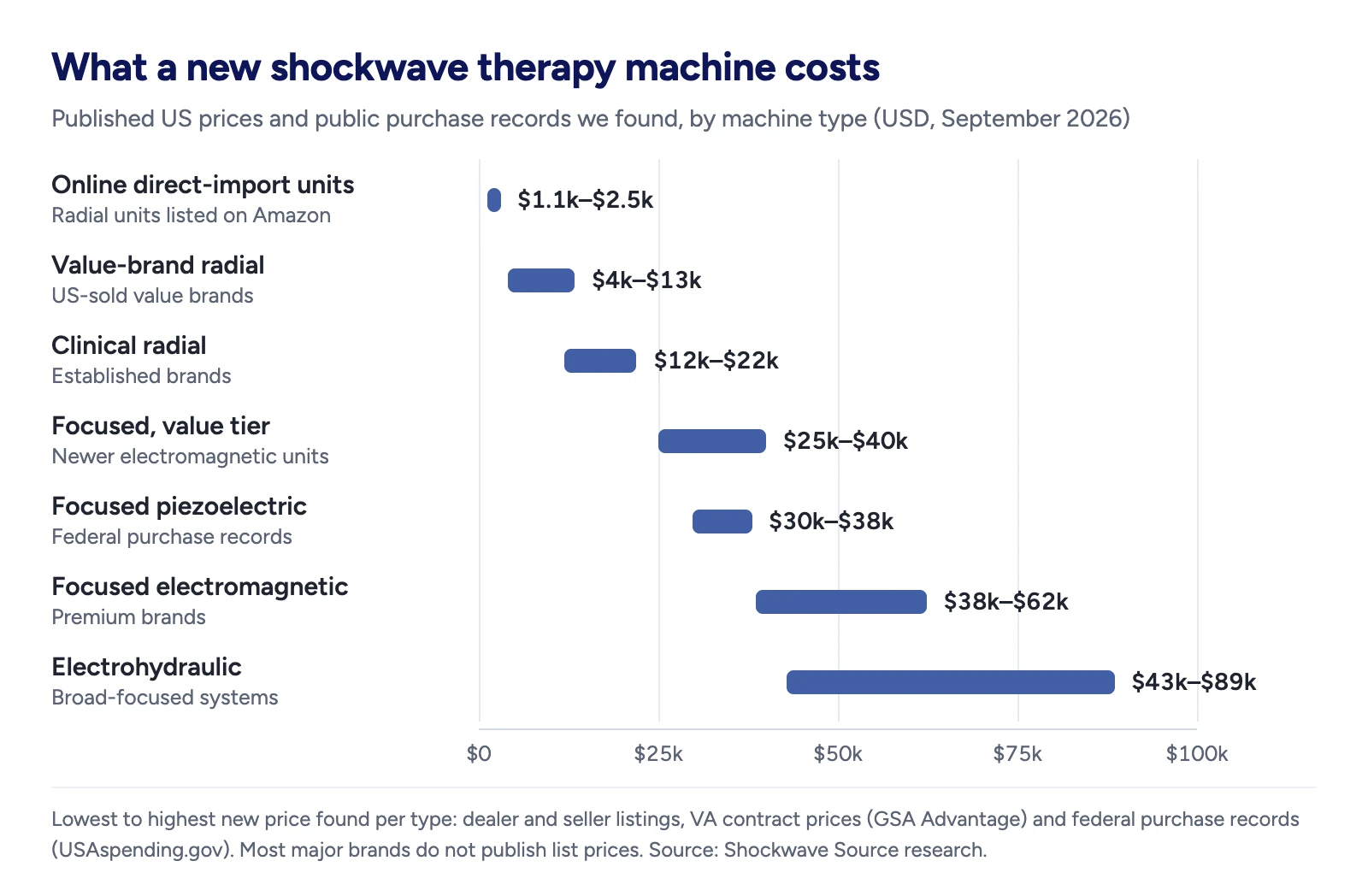
What shockwave machines cost, by type
| Machine type | New price range | What the range is based on |
|---|---|---|
| Online direct-import radial units | $1,100–$2,500 | Amazon listings; those we checked make no FDA claims |
| Value-brand radial units | $4,000–$13,000 | US sellers' own price lists |
| Clinical radial, established brands | $12,000–$22,000 | US dealer listings and VA contract prices |
| Focused, value tier | $25,000–$40,000 | US dealer listings |
| Focused piezoelectric | $30,000–$38,000 | Federal purchase records |
| Focused electromagnetic, premium brands | $38,000–$62,000 | US dealer listings and federal purchase records |
| Electrohydraulic (broad-focused) | $43,000–$89,000 | VA contract prices and federal purchase records |
Radial machines are where most clinics start. The Chattanooga Intelect RPW2, one of the most widely stocked, is listed at $15,995 to $20,763 by US dealers such as US MedRehab and TENSnet, and the VA's supply contract prices it at about $15,700 on GSA Advantage. A Zimmer enPuls 2.0 was on sale for $11,945, and portable radial units from established brands start around $7,000.
Focused machines cost two to three times as much. The Chattanooga Intelect Focus is listed at $49,404 to $59,562 by US dealers such as SourceOrtho and TENSnet. STORZ doesn't publish prices, but public records show federal buyers paying from $38,500 to $62,349 for a DUOLITH SD1 T-TOP ultra, and from $29,749 to $38,000 for PiezoWave piezoelectric systems. A newer value tier of focused units lists at $24,999 to $39,999.
Electrohydraulic machines sit at the top. The VA's supply contract lists SoftWave systems at $78,392 to $88,442 on GSA Advantage, and federal buyers have paid from $65,000 to $88,500. A Medispec system went to the VA for $42,938.
At the bottom, radial units on Amazon sell for about $1,100 to $2,500, and value brands sold in the US run from $3,949 to $13,349, with Oceanus in between at $9,999 for its PhysioPRO. None of the Amazon listings we checked makes an FDA claim, and one US value seller says that, apart from any FDA-cleared indications in its documentation, its devices "have not been evaluated or approved by the FDA for medical treatment purposes." Treat these as a different category, not a cheaper version of the same machine.
A note on the numbers. Federal prices are a reality check, not a promise: they reflect contract terms, bundles and volumes a private clinic may not get. Be wary, too, of price ranges repeated across the web. One online price guide puts a new EMS DolorClast at $40,000 to $75,000, while the VA's contract price for a DolorClast radial starter pack is $19,124.
Why most brands won't give you a price
Most of the big names don't publish prices. We found no public US price from STORZ, BTL, Dornier or Richard Wolf, and Zimmer's own store says "Call for Pricing" even though its dealers list prices. In our Discover guide, 15 of the 22 machines we cover show "Not publicly listed" for that reason, and three of the seven that do show a price are Chattanooga units we sell ourselves.
"Price on request" is not a trick, but it does mean the number depends on the conversation. The same console can be quoted with one handpiece or two, a few transmitters or a full set, with or without a cart, training or a longer warranty. That is why two clinics can pay very different prices for what looks like the same machine.
The fix is simple: ask each seller for an itemized written quote, and compare quotes line by line rather than on the bottom number.
What pushes the price up or down
- Radial or focused. Radial (pneumatic) machines spread energy from the skin surface and cost the least. Focused machines concentrate energy at a chosen depth and cost more. They do different jobs, so compare like with like. Our radial vs. focused guide explains the difference.
- Energy and depth. More output and a deeper focus cost more to build.
- What is in the box. Extra handpieces, transmitters (the interchangeable heads on a radial handpiece), stand-offs, a cart and software protocols all move the price.
- The regulatory record. An FDA record covers a specific device configuration and its stated uses. Check that it matches the exact model you are buying and the conditions you plan to treat. Our machine pages list the records we found for each machine.
- Service and warranty. Local service and a longer warranty usually cost more, and they are often worth it. Published warranties range from one year on some value units to three years on the RPW2 console.
- New, demo or used. Showroom and used units sell for less, with trade-offs we cover below.
The costs that come after the invoice
Every radial machine has parts that wear out by design: the projectile inside the handpiece and the transmitters at its tip are rated for a set number of shocks. Focused machines have their own consumables. These are the published US prices we found:
| Part | Published US price | How often |
|---|---|---|
| Radial handpiece revision kit | $346 (Chattanooga, covers two overhauls) to $725 (EMS) | About every 1 million shocks |
| Radial transmitter or applicator head | $300 (Zimmer) to $431 (Chattanooga) each | From 150,000 shocks (Zimmer) to about 1 million (Chattanooga) |
| Replacement radial handpiece | $3,795 (Zimmer set) to $4,390 (EMS) | Service life of about 5 million shocks, with overhauls done |
| Focused coil (Chattanooga Intelect Focus) | $3,256 to $3,999 | Every 2 million shocks |
| Focused stand-offs | $192 to $259 | At least every 12 months |
| Piezoelectric therapy source (PiezoWave) | $6,900 to $8,400 list | Rated for 5 million pulses |
| Hands-on training course (optional) | $2,999 to $3,299 per clinician | One-time; some sellers include training |
Two things stand out. First, wear parts are affordable if you replace them on schedule and expensive if you don't: Chattanooga's warranty on the RPW2 handpiece depends on doing those overhauls. Second, none of the major brands publishes a price for an extended warranty or service plan, so ask for one in writing before you sign.
Rent, lease or buy: how to decide for your practice

The price tag matters less than how sure you are that your patients will use the machine. The three ways to get one line up with how much you know.
| Rent | Lease | Buy | |
|---|---|---|---|
| Upfront cost | Low: first month and delivery | Low: often no down payment | The full price, or a loan |
| Monthly cost | Highest for the same machine | A fixed payment | None once it is paid for |
| Commitment | Month to month, or a short contract | Usually 12 to 60 months | You own it |
| At the end | Hand it back | Buy it, return it or upgrade | Keep it, sell it or trade it in |
| Best for | Testing demand | Proven demand, protecting cash | High, steady volume for years |
Rent when you are testing demand
Renting is the smallest commitment you can make. You pay month to month, the machine goes back if patients don't take to it, and you learn what you need to know: will your patients pay cash for shockwave, and how often will you use the machine? If you are not sure there is demand, that answer is worth paying for.
You do pay for the flexibility. Rentals cost more per month than a lease on the same machine, and unless the contract says otherwise, nothing you pay goes toward owning it.
Rentals of clinical machines are also harder to find than you might think. Most sellers don't advertise them, and we found no US rental company publishing rates. The only published monthly rates we found came from Myosyte, a shop connected to Shockwave Source: $550 a month for a PiezoWave focused unit on a six-month contract (2023), and $800 a month with no contract (2024 to 2025). The difference is the price of flexibility: skipping the contract cost $250 a month more.
If you can't find a rental, there are other ways to test demand before you commit:
- Book a demo. Distributors such as CuraMedix, which sells STORZ machines, offer in-office demonstrations.
- Use a money-back window. Oceanus offers a 30-day money-back guarantee, and OmniWave promises a refund within 90 days if the machine hasn't paid its way, provided you complete its onboarding program.
- Defer the payments. Some equipment lenders, such as NCMIC, defer the first payment by up to 90 days, which gives you time to see how the machine performs before payments start.
Whatever you rent, ask whether your rent can be credited toward a lease or purchase if you decide to keep the machine. We found no published offer that does this automatically. If you are planning around a seasonal rush, our cost analysis of renting for fall demand runs the numbers.
Lease once you know the demand is there
A lease spreads the cost over a fixed term, usually 12 to 60 months, with the same payment every month and little or no cash up front. It suits a practice that knows patients want the treatment and would rather keep its cash for staff and marketing.
Few sellers publish lease payments, but the ones we found run from about $380 to $1,170 a month. Our own lease estimates are $380 a month for the Chattanooga Intelect Mobile 2 RPW, $428 for the Intelect RPW2 and $1,166 for the Intelect Focus, and Oceanus advertises $500 a month for its PhysioPRO. You can see our current estimates on the products page.
Before you sign, check three things:
- The structure. With a $1-buyout lease you own the machine at the end, and the payments are higher. With a fair-market-value lease the payments are lower, and at the end you buy the machine at its market value, return it or renew (Pathward).
- The rate. None of the shockwave sellers we looked at publishes an APR. NerdWallet puts equipment financing at roughly 4% to 15% APR from banks and SBA lenders and 6% to 45% from online lenders. Ask for the rate and the total of all payments.
- Fees and teasers. Documentation fees run from $79 to $499 at one lender, and NCMIC charges $200. Watch for "$99 a month" offers that step up after the first six to twelve months.
Buy when volume is proven and you will keep it for years
Buying costs the least over the life of the machine, as long as it stays busy. You pay no interest, you face no end-of-lease decision, and you can sell or trade the machine in later.
Taxes can soften the upfront cost. For tax years beginning in 2026, Section 179 lets a business deduct up to $2,560,000 of qualifying equipment in the year it is placed in service, with the limit reduced once total purchases pass $4,090,000 (IRS Rev. Proc. 2025-32). And 100% bonus depreciation is now permanent for property acquired after January 19, 2025 (IRS). Ask your accountant how that applies to your practice.
The trade-off is risk. Once the warranty ends, repairs and wear parts are yours, and so is the chance that newer technology makes your machine less appealing to patients.
What about buying used?
Used machines can save a lot, but only if the price reflects the wear. These are asking prices we found in the US:
- Chattanooga Intelect RPW2 and Mobile 2 RPW: $10,000 to $14,100, against about $16,000 to $19,000 new.
- Chattanooga focused units: $35,000 to $36,000, against about $49,000 to $60,000 new.
- PiezoWave 2: $15,000 to $22,500.
- SoftWave OrthoGold 100: $37,000 to $41,000.
Most used sales are as-is with no returns, and handpieces, carts and foot pedals are often missing. Handpiece life is the biggest unknown: one used Zimmer enPuls we found was listed with its handpiece counter past 2 million pulses, beyond Zimmer's 2-million-pulse guarantee, and a replacement handpiece set costs $3,795. Ask for the shot count and the service history, check that the manufacturer or an independent technician will service the machine, and be careful with units built for the European or Canadian market, which may not match a US FDA record.
What a machine can earn: the break-even math
The price only makes sense next to what the machine brings in, and for most shockwave treatment that means cash.
Insurance mostly doesn't pay. UnitedHealthcare, Cigna, Anthem and the Blue Cross Blue Shield Federal Employee Program all treat shockwave for musculoskeletal conditions as unproven, investigational or not medically necessary. Aetna covers it only for chronic calcific shoulder tendinopathy. Medicare has no national coverage decision, and the one local decision, which covers Alabama, Georgia, North Carolina, South Carolina, Tennessee, Virginia and West Virginia, says high-energy shockwave for musculoskeletal conditions is not covered (CMS). At UChicago Medicine, shockwave is "a self-pay service." If you treat Medicare patients and expect Medicare to deny the claim, have them sign an Advance Beneficiary Notice before treatment.
What clinics charge. We found 14 US clinics in 11 states that post a price for a single session. They charge from $60 to $250, and the median is $150: for example, $60 at Columbia Gorge Physical Therapy in Oregon, $150 at SportsCare Physical Therapy in Georgia and $250 at Tanglewood Foot Specialists in Houston. Packages of three sessions run from $225 to $650. A typical course is three to five sessions, one to two weeks apart, according to a 2025 international expert consensus in the British Journal of Sports Medicine.
The math. At the $150 median, three sessions a month cover a $428 monthly lease payment, our estimate for an Intelect RPW2. Buying the same machine at $18,776 takes about 125 sessions to pay back, or 25 patients who each complete a five-session course. That is before wear parts, staff time and marketing, so treat it as a floor, not a forecast. The ROI calculator on our leasing page lets you run your own numbers.
If you are a physical therapist, check your state practice act before you add shockwave. The 2023 plantar fasciitis guideline from the Academy of Orthopaedic Physical Therapy treated shockwave as outside the scope of physical therapist practice for that update.
Questions to ask before you sign
- What exactly is included: how many handpieces and transmitters, a cart, stand-offs, training?
- How many shocks are the handpiece and transmitters rated for, and what do replacements cost?
- How long is the warranty, and what would void it, such as skipped overhauls?
- Which FDA record covers this exact model and configuration, and for which uses?
- Who services the machine near you, and how quickly?
- For a lease: what are the term, the APR, the total of all payments and the end-of-lease options?
- For a rental: what are the minimum term and delivery costs, and can rent be credited toward a purchase?
- For a used machine: what are the shot count and service history, and will the manufacturer service it?
The bottom line
A new clinical shockwave machine costs about $12,000 to $22,000 for a radial unit from an established brand and about $30,000 to $62,000 for a focused one. The price tag is only part of the decision. Budget for wear parts, plan on patients paying cash, and match the way you get the machine to what you know: rent to test demand, lease once it is proven, and buy when your volume will keep the machine busy for years. To compare machines side by side, including prices where they are published, start with our Discover guide.
Frequently asked questions
How much does a shockwave therapy machine cost?
New clinical machines from established brands cost about $12,000 to $22,000 for radial units and about $30,000 to $62,000 for focused units. Electrohydraulic systems run about $43,000 to $89,000, and value brands sold in the US start around $4,000.
How much does it cost to lease a shockwave machine?
The published lease payments we found run from about $380 to $1,170 a month, usually over 12 to 60 months. The rate, the term and the end-of-lease option all change the total you pay.
Can you rent a shockwave therapy machine?
Yes, but rentals of clinical machines are uncommon and rarely have published prices. Expect to pay more per month than you would for a lease, and ask whether rent counts toward buying. Demos, money-back windows and deferred payments are other ways to test demand.
Is a cheap shockwave machine worth it?
Radial units under $2,500 are sold online, but the ones we checked make no FDA claims. For clinical use, compare the regulatory record, the warranty, local service and the cost of wear parts, not just the price.
Does insurance cover shockwave therapy?
Rarely, for musculoskeletal conditions. Major commercial insurers treat it as unproven or investigational, and Medicare has no national coverage decision, so most clinics offer shockwave as a self-pay service.
Upgrade your practice
Bring the latest shockwave technology to your patients.
- Flexible leasing options
- Training included
- Equipment support